
China Market Expansion Cooperation Plan for US Supplement Brands
Provider: Alikea
Date: January 29, 2026
I. Executive Summary
This plan is tailor-made for Brand owner‘s China market expansion, with Alikea providing diversified cooperative operation services. Leveraging Brand owner‘s product and brand advantages, combined with Alikea’s qualification resources, channel capabilities, and professional operation strength, we will build a gradient cooperation model of “Basic Operation Agency – In-depth Authorization – Procurement and Distribution”. This model aims to help Brand owner quickly establish stable sales channels, enhance brand awareness, and achieve sustainable profit growth in China. The core cooperation principle is “clear responsibilities and rights, risk sharing, and benefit sharing”, ensuring that cooperation at all stages is safe, efficient, and mutually beneficial.
II. Market Background and Opportunity Analysis
2.1 Overview of China’s E-commerce Market
2.1.1 Domestic Health Product Market
Indicator Category | Specific Data |
Market Scale and Growth | 2023: Over RMB 3.5 trillion; 2025 (forecast): Over RMB 4.3 trillion; YoY Growth Rate: Over 10% |
E-commerce Channels (2023) | Sales Volume: RMB 142.1 billion; Channel Share: Approximately 50%; YoY Growth Rate: 32.3% |
Penetration Rate and Consumption | Per Capita Consumption Growth Rate: Over 6%; Penetration Rate: Far lower than that of the United States |
2.1.2 Cross-border Imported Health Product Market
Indicator Category | Specific Data |
Market Scale (2022-2025) | 2022: RMB 560 billion; 2025 (forecast): RMB 1.32 trillion; Doubled in 3 years |
Major Importing Countries | United States (20.7%), Australia (13.8%), Germany, Japan; The United States ranks first |
Core Channels | Tmall/JD (leading channels); Douyin Global Shopping (emerging channel); Douyin: Swisse’s sales reached RMB 150 million during Double 11 in 2024 |
2.2 Brand owner‘s Market Opportunities in China
Brand owner‘s products have significant advantages in [product quality, technical strength, brand reputation, etc.], which are highly aligned with the consumption upgrading needs of Chinese consumers. However, without professional localized operation support and flexible cooperation models, it may face problems such as poor platform adaptability, vague marketing positioning, and low market promotion efficiency. Alikea has launched diversified cooperation solutions, which can select suitable models according to Brand owner‘s development needs, effectively solve the above pain points, and help convert potential market opportunities into actual sales performance.
2.3 Profit Advantages in China Market: Cost Comparison with Amazon Platform and Case Reference
As an Amazon health product seller, Brand owner is well aware of the impact of platform fees on profits. China’s mainstream e-commerce platforms and distribution channels, with the characteristics of “low fees, high unit price, and multi-channel revenue”, can bring higher profit margins for Brand owner. The following is a cost and profit comparison based on typical health product categories (taking “Solgar Vitamin B Complex 100mg 100 Capsules” as an example), and a channel to obtain the real financial model of cooperative customers is provided:
2.3.1 Core Cost Comparison: Amazon US Station vs. China’s Mainstream E-commerce Platforms (Taking One Bottle of Solgar Vitamin B Complex 100mg 100 Capsules as an Example)
Cost Item | Amazon US Station (Reference Standard) | Tmall Global/JD International (Alikea Cooperative Channels) | Difference Analysis |
Platform Commission | 15% | 4% (Tmall Global), 6% (JD International) | China’s platform commission is about 10 percentage points lower |
Logistics and Warehousing Fees | Approx. $3.5 per order (FBA small items) | Approx. RMB 9.5 per order (international transportation: approx. RMB 5 per bottle + bonded warehouse dropshipping: RMB 4.5) | Based on exchange rate 1:7, China’s cost is 30%+ lower |
Advertising and Promotion Cost Ratio | 15%-20% | About 10% (no advertising investment in distribution channels) | China’s channel promotion cost is 5-10 percentage points lower |
Other Service Fees (e.g., Compliance) | Approx. $500-$1,000 per year (compliance review, tool fees) | Included in Alikea’s operation service fee (no additional charge) | No additional compliance costs for cooperation in China |
2.3.2 Profit Margin Calculation (Based on Real Data of One Bottle of Solgar Vitamin B Complex 100mg 100 Capsules)
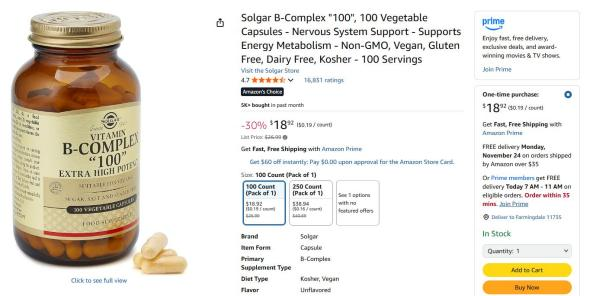
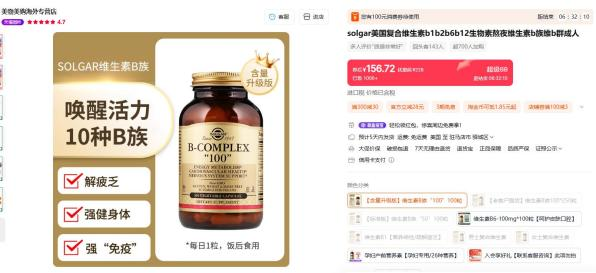
Product Parameters: Procurement Cost: $11.5 per bottle; Amazon Selling Price: $18.92 per bottle; Selling Price of Market In the Box’s Tmall Store in China: RMB 156.72 (approx. $22.04)
• Profit per bottle on Amazon US Station:
Selling Price ($18.92) – Procurement Cost ($11.5) – Platform Commission ($2.83, 15%) – Logistics Fee ($3.5) – Advertising Fee ($0, no advertising for follow-up sales) = $1.09 (Profit Margin: approx. 5.76%)
• Profit per bottle on China’s Platform:
Selling Price (RMB 156.72) – Procurement Cost (RMB 80.5, $10.5 × 7) – Platform Commission (RMB 6.27, 4%) – Logistics Fee (RMB 9.5) – Advertising Fee (RMB 15.7, 10%) = RMB 44.75 (approx. $6.39, Profit Margin: approx. 28.55%)
|
|
2.3.3 Real Profit Cases of Cooperative Customers: Contact to Obtain Customized Financial Model
Similar health product customers served by Alikea (such as the product in the above case) have achieved higher profit levels than the Amazon platform after entering the Chinese market:
If Brand owner needs to further understand: ① China market profit calculation matching its own products; ② Real sales data and financial statements of cooperative customers;
For the investment return period under different cooperation models, you can contact Alikea’s exclusive contact person at:info@alikea.com to obtain a customized financial model (including desensitized profit data of cooperative customers) to assist in decision-making. |
III. Cooperation Models (Diversified Options)
To meet Brand owner‘s market expansion needs at different stages, Alikea provides three differentiated cooperation models. Both parties can flexibly adjust the cooperation method according to the cooperation progress and performance. Each model includes a complete process of qualification handling, supply chain, operation, and payment settlement to ensure compliant and efficient cooperation. The core differences are as follows: Model 1 is Alikea acting as an operation agent for Brand owner‘s store, with in-depth collaboration between the two parties; Model 2 is Alikea opening an independent store with Brand owner‘s authorization and operating independently; Model 3 is Alikea purchasing Brand owner‘s products and selling them in its own stores, maintaining only procurement cooperation.
3.1 Model 1: Brand owner Qualification Flagship Store Operation Agency Model (Basic Model)
3.1.1 Qualification and Store Setup Process
• Qualification Preparation: Brand owner provides basic qualifications such as business license, brand trademark registration certificate, product quality inspection report, and import license (if required); Alikea assists in organizing qualification documents to ensure compliance with the entry requirements of China’s e-commerce platforms and the regulatory regulations of the health product industry.
• Platform Entry: Alikea submits entry applications to target platforms such as Tmall, JD, Pinduoduo, and Douyin in Brand owner‘s name, assigns a dedicated person to connect with the platform investment and review team, timely feeds back review opinions and supplements materials, and completes entry in about 30 days.
• Entry Fees: Tmall Global deposit: RMB 50,000 (refundable) + technical service fee: RMB 30,000/year; JD International deposit: $5,000 (refundable); Douyin Global Shopping deposit: RMB 500 (refundable); Pinduoduo Global Shopping deposit: $1,000 (can be deducted from payment, refundable). The above fees are officially collected by the platform and paid directly by Brand owner. Alikea assists in fee payment and invoice connection.
• Store Setup: Alikea completes the store homepage design, product classification structure setup, detail page production, and brand story presentation according to Brand owner‘s brand tone and Chinese consumers’ aesthetics, and configures the customer service system and order management system simultaneously to ensure the store functions are complete.
3.1.2 Supply Chain Full-process Details
• Product Selection and Filing (Driven by Big Data AI): Relying on professional e-commerce data analysis tools, Alikea builds a full-dimensional market insight system through big data AI functions to provide scientific decision support for product selection and accurately position product directions suitable for the Chinese market. It is divided into three core sections, as follows:
• Section 1: Market Competition Insight – Identify Differentiated Opportunities
Through the competition monitoring module of the e-commerce data analysis tool, accurately identify the core competitors of Brand owner‘s similar products (such as GNC from the United States, Swisse from Australia, etc.), and conduct in-depth analysis of key dimensions: ① Sales Performance: Sales volume and transaction growth rate of competitors in the past 30-90 days; ② Pricing Strategy: Distribution of mainstream price bands, discount intensity, and price fluctuation rules; ③ Traffic Structure: Core traffic sources (search/advertising/campaigns) and conversion efficiency; ④ Promotion Methods: Common promotion forms (full reduction/gift with purchase/combo package) and campaign effects. Based on the analysis, clarify market gaps (such as insufficient supply in the segmented category of “mid-to-high-end children’s fish oil”) and Brand owner‘s product differentiation advantages.
• Section 2: Accurate Product Selection Guidance – Anchor Potential Bestsellers
Based on the search heat monitoring function of the data analysis tool, focus on three core actions: ① Keyword Mining: Extract core demand keywords with high search volume (daily search ≥ 5,000) and high conversion rate (conversion ≥ 3%) in the health product category, such as “high-absorption calcium”, “children’s vitamin D”, “women’s multivitamins”, etc.; ② Demand Decoding: Analyze consumer attribute preferences behind keywords, such as “additive-free”, “chewable tablets”, “small dosage”, “portable packaging”, etc.; ③ List Output: Combine Brand owner‘s product matrix, screen potential products that meet the needs, sort them by “market demand + product competitiveness”, and form a product selection list with clear priorities for Brand owner‘s confirmation.
• Section 3: Intelligent Stock Preparation in Advance – Predict Demand Fluctuations
Through the industry operation data module of the data analysis tool, integrate the category market data and sales rules of similar stores, and superimpose AI algorithms to realize: ① Cycle Prediction: Identify the demand fluctuation characteristics of seasonal cycles (calcium supplementation peak in winter, increased demand for immune products in spring) and major platform promotion nodes (618, Double 11); ② Volume Calculation: Output initial stock preparation suggestions for each potential product, and mark the safety stock threshold (such as the stock of best-selling products ≥ 1.5 times the estimated sales volume in the past 30 days); ③ Node Reminder: Set a replenishment trigger node (reminder starts when inventory is less than 50% of the safety stock). After both parties confirm the products, Alikea completes the filing of imported health products, the filing of e-commerce platform commodities, and the filing of cross-border commodity lists of the General Administration of Customs in Brand owner‘s name, and obtains the filing certificate (ensuring the filing information is consistent with the product information). After the filing is completed, the procurement process is initiated.
Procurement and Stock Preparation: Brand owner organizes product procurement independently. Alikea provides accurate procurement volume suggestions based on market demand forecasts, historical sales data, and peak and off-season rules to avoid inventory backlogs or stockout risks.
International Transportation: Brand owner arranges international logistics to ship the goods to Alikea’s designated bonded warehouses (such as Ningbo Bonded Warehouse, Guangzhou Bonded Warehouse, Chongqing Bonded Warehouse, Hong Kong GFC Warehouse, etc.). The logistics bill of lading, estimated arrival time and other information must be synchronized to Alikea 3 working days before arrival; if Brand owner is inconvenient to arrange, it can entrust Alikea to complete the international transportation through cooperative logistics providers (such as DHL, FedEx), and the fees shall be borne by Brand owner.
Customs and Commodity Inspection: Alikea organizes customs declaration materials (including procurement contract, packing list, commercial invoice, filing certificate, etc.) 5 working days in advance, and submits customs declaration through China’s international trade “Single Window” system; assigns a dedicated person to connect with customs and commodity inspection departments, assists in completing cargo inspection, tax calculation (customs duty + value-added tax) and payment, and ensures customs clearance within 3-5 working days. After customs clearance, the certificate is synchronized to Brand owner.
Bonded Warehouse Operations: After customs clearance, the goods will be delivered to the bonded warehouse. Alikea supervises the warehouse to sort and put the goods on the shelves, and issues a sorting report to synchronize to Brand owner; subsequent order shipment is carried out by Alikea issuing delivery instructions, and the bonded warehouse completes picking and packing, then connects with domestic logistics for shipment.
Bonded Warehouse Transfer: If bonded warehouse transfer is required (including in-warehouse transfer or cross-warehouse transfer), Alikea is responsible for the full-process operation, including verifying product filing information, preparing transfer orders, coordinating logistics delivery, and supervising sorting; the progress is synchronized within 24 hours after the transfer starts, and the inventory data is updated and synchronized to Brand owner immediately after completion to ensure accurate inventory information.
3.1.3 Operation Process
• Product Operation: Alikea optimizes product titles, keywords, and main images, and improves search rankings in combination with platform algorithm rules; updates product detail pages regularly, highlights core selling points such as ingredients and efficacy, and complies with China’s health product promotion standards.
• Marketing Promotion: Plans major platform promotions (Double 11, 618, etc.) and daily marketing activities, and launches paid advertisements such as Taobao Tmall Express and JD Express; cooperates with KOLs/KOCs in the health field to carry out content seeding and enhance brand exposure.
• Customer Service: Provides 7×15 hours of online customer service to answer product inquiries, handle order issues and after-sales disputes, and ensure customer satisfaction reaches over 95%.
• Data Monitoring: Generates weekly operation reports, analyzes core indicators such as traffic, conversion rate, and repurchase rate, and puts forward strategy optimization suggestions to synchronize to Brand owner.
3.1.4 Payment and Collection Process
• Consumer Payment: The store is bound to the collection account under Brand owner‘s name. Chinese consumers complete transactions through WeChat Pay and Alipay, and the funds directly enter the platform supervision account.
• Collection Cycle: The collection cycle is subject to the official rules of the cooperative e-commerce platform. There are differences in the settlement cycles of different platforms. Alikea will synchronize the specific settlement rules and cycle adjustment notices of the cooperative platforms in advance to ensure Brand owner clearly grasps the collection nodes.
• Collection Path: The settled funds are directly transferred by the platform to Brand owner‘s designated U.S. bank account, supporting direct U.S. dollar settlement; Alikea assists in providing transaction flow, customs declaration certificates and other materials required for settlement to ensure compliant fund outflow.
• Collection Timeliness and Fees: The time for funds to be transferred from the platform to the U.S. bank account is 3-5 working days. The fees include platform commission and foreign exchange settlement fees. Alikea provides a detailed fee list.
• Bill Management: Provide Brand owner with the previous month’s fund settlement details, including sales volume, deducted fees, and actual collection amount, before the 10th of each month to ensure clear and traceable fund flow.
3.1.5 Fees and Settlement
• Basic Service Fee: A fixed monthly fee is charged, covering routine and basic practical services such as basic store operation, data monitoring, customer service connection, multi-brand product maintenance, compliance registration, customs clearance assistance, and return processing.
• Sales Commission: Calculated as a percentage of the actual monthly sales volume. The commission rate is determined through negotiation based on the product category and sales target, realizing the linkage between service value and sales performance.
• Software Subscription Fee: If the MboomTech S2B2C system is used for distribution management or the Shipedge system is used for warehousing and fulfillment management, the corresponding software subscription fee shall be paid on a periodic (monthly/annual) basis. The specific fee is determined according to the scope of system functions used.
• Distribution Development Service Fee and Commission: If distribution business is carried out, Alikea charges a special distribution development service fee. At the same time, for the sales volume generated by Brand owner promoting Alikea’s own brand and Chinese factory OEM brand in the “reverse distribution” model, a distribution commission is paid to Brand owner according to the agreed ratio.
• Project Fee: For value-added services such as API docking, customized system development, and in-depth data analysis, a special project fee is charged based on the overall project or phased results. The fee amount is negotiated separately according to project requirements.
3.2 Model 2: Alikea Entity + Brand owner Exclusive Authorization Model (Independent Operation Model)
Core Positioning: Brand owner issues an exclusive brand authorization to Alikea. Alikea establishes a Brand owner brand-exclusive store on platforms such as Tmall Global and JD International with its own entity, and is fully responsible for the entire process of procurement, operation, marketing, etc. The store operation and subsequent revenue have no connection with Brand owner. Brand owner only obtains fixed procurement income through product sales.
3.2.1 Qualification Authorization and Store Setup Process
• Exclusive Authorization Handling: Brand owner issues a written “Exclusive Brand Authorization Letter” to Alikea, clearly authorizing Alikea to establish and operate a Brand owner brand store on designated e-commerce platforms such as Tmall Global and JD International in China with its own company entity. The authorization scope includes brand use, product sales, and market promotion, and the authorization period is specified; at the same time, it provides a complete set of qualification documents such as trademark registration certificate, product quality inspection report, and certificate of origin for Alikea to complete platform entry and filing.
• Entity Filing and Entry: Alikea completes the platform entry application and filing with its own e-commerce operation qualifications, import qualifications, and Brand owner‘s authorization documents to ensure compliance with the “operating entity + brand authorization” requirements. The entire entry process is completed independently by Alikea, and Brand owner only provides necessary qualification support.
• Store Setup and Confirmation: Alikea independently completes the store visual design, structure setup, and function configuration. The ownership and operation right of the store belong to Alikea; the store name and brand presentation method must be confirmed with Brand owner in advance to ensure compliance with brand standards. After confirmation, Alikea makes independent decisions on relevant operation decisions of the store.
3.2.2 Supply Chain Full-process Details (Independently Responsible by Alikea)
• Product Selection and Filing: Based on the demand of China’s cross-border health product market and platform rules, Alikea screens suitable Brand owner products and forms a procurement list. After Brand owner confirms the product supply capacity, Alikea completes the filing of imported health products, platform commodity filing, and customs cross-border list filing in its own name. Brand owner‘s participation is not required throughout the filing process.
• Procurement Cooperation: Both parties sign a “Product Procurement Agreement”, clarifying the procured products, quantity, unit price, payment method, and delivery cycle; Alikea pays the procurement funds in accordance with the agreement, and Brand owner only needs to deliver qualified products on time in accordance with the order requirements. After delivery, all responsibilities and obligations for the batch of products are completed.
• International Transportation and Customs Clearance: Alikea independently arranges international logistics (or entrusts a third-party logistics provider) to pick up the goods from Brand owner‘s designated warehouse and ship them to Alikea’s designated bonded warehouse; independently organizes customs declaration materials, completes customs declaration, commodity inspection connection, and tax payment through the “Single Window”, and independently bears the fees and risks throughout the process. After customs clearance, Alikea synchronizes the delivery confirmation to Brand owner.
• Warehousing and Shipment: After the goods enter the bonded warehouse, Alikea establishes an independent inventory management system and is responsible for the entire process of sorting, shelving, order picking, and domestic logistics connection; operations such as bonded warehouse transfer are independently decided by Alikea, and there is no need to synchronize inventory dynamics and shipment information to Brand owner.
3.2.3 Operation and Marketing Process (Independently Led by Alikea)
• Store Operation: Alikea independently undertakes daily operation work such as product title optimization, detail page production, and customer service. The product pricing is independently determined by Alikea based on the procurement cost and market conditions, and does not need to be reviewed by Brand owner.
• Omni-channel Marketing: Alikea invests special funds in marketing promotion, including platform promotion application, direct train/express advertisement launch, cooperation with KOLs in the health field, content seeding, etc. Alikea makes independent decisions on marketing strategies and expense expenditures, which have no connection with Brand owner.
• Data and Risk Control: Alikea independently monitors core data such as store traffic and conversion rate, and adjusts operation strategies in a timely manner; Alikea independently undertakes and solves problems such as returns and exchanges, complaint disputes, and compliance risks arising from store operations. Brand owner does not participate in any subsequent problem handling.
3.2.4 Payment and Collection Process
• Consumer Payment: The store is bound to the collection account under Alikea’s name. Consumers complete payment through Alipay, WeChat Pay, international credit cards, etc., and the funds directly enter Alikea’s account.
• Platform Settlement and Revenue: The sales funds are directly settled by the e-commerce platform to Alikea’s corporate account, and the revenue belongs to Alikea. Brand owner only obtains fixed income through product procurement.
3.2.5 Fees and Responsibility Boundaries
• Fee Division: Brand owner only collects product procurement funds and does not bear any fees for operation, marketing, logistics, customs clearance, etc.; Alikea bears all fees and risks in the entire process after procurement, including: ① Software Subscription Fee: Periodic subscription fees for using MboomTech and Shipedge systems; ② Project Fee: Special fees for value-added needs such as API docking and customized system services; ③ Distribution-related Fees: Development costs incurred in independent distribution business. At the same time, the commission obtained from promoting Alikea’s brand in the “reverse distribution” model belongs to Alikea.
• Core Responsibilities and Rights: Brand owner is responsible for providing qualified products and authorization documents; Alikea has full operation rights of the store, and independently decides the pricing, promotion, and shelving strategies. Except for product quality issues, there is no other business connection between the two parties.
3.3 Model 3: Alikea Existing Store Procurement and Shelving Model (Procurement and Distribution Model)
Core Positioning: Alikea obtains products from Brand owner through procurement, directly shelves them in its existing mature stores such as Tmall Global and JD International for sales, and realizes rapid monetization by using the existing store traffic and operation resources. Only a product procurement cooperation relationship exists between the two parties.
3.3.1 Cooperation Preparation and Qualification Process
• Basic Authorization and Qualification Provision: Brand owner issues a product sales authorization letter to Alikea, clearly authorizing Alikea to sell designated categories of products in its existing stores; at the same time, provides product quality inspection reports, materials required for import filing, etc., for Alikea to complete product shelving filing.
• Product Filing: Alikea completes the shelving filing of the product on the corresponding platform with its own store entity and the qualifications provided by Brand owner, and the filing process is completed independently.
3.3.2 Supply Chain Full-process Details
• Procurement Plan and Cooperation: Based on its own store sales data, customer portraits, and inventory status, Alikea submits a regular procurement plan to Brand owner, clarifying the product category, quantity, and delivery time; both parties sign a “Procurement Agreement”, confirming the procurement unit price and payment method, and Alikea pays the procurement funds in accordance with the agreement.
• Logistics and Goods Receipt: Alikea independently arranges international logistics to pick up the goods from Brand owner‘s designated warehouse, or requires Brand owner to ship the goods to Alikea’s designated domestic warehouse/bonded warehouse; Alikea bears the logistics fees and transportation risks. After the goods are inspected and accepted into the warehouse, both parties complete the delivery confirmation of the batch of products.
• Customs Clearance and Warehousing: Alikea completes customs declaration, commodity inspection, and tax payment in its own name. After customs clearance, the goods are stored in its own warehouse or cooperative storage point, and an independent inventory management system is established.
• Shelving and Sales: Alikea shelves the procured products in the health product section of its existing stores, and conducts product display and sales in combination with the existing operation strategy of the store, and independently formulates the sales price and promotion activities.
3.3.3 Operation and Marketing Process
• Store Operation: Rely on Alikea’s existing store customer service team and order system to complete product consultation, order processing, etc., and share operation resources with other products in the store without separately configuring a team.
• Joint Marketing: Incorporate Brand owner‘s products into the store’s overall marketing plan, and promote them in combination with store promotions and daily activities. Alikea bears the marketing fees.
• After-sales and Risks: Alikea handles returns and exchanges, quality complaints and other issues arising from product sales first; if it is indeed a product quality problem, it can apply for after-sales connection with Brand owner with relevant certificates. For non-quality problems, Alikea bears the responsibility independently.
3.3.4 Payment and Collection Process
• Procurement Payment: Alikea pays the funds in accordance with the agreement in the procurement agreement.
• Sales Collection: After consumers complete the payment in Alikea’s existing stores, the funds are directly settled to Alikea’s account, and Alikea independently enjoys the sales revenue.
3.3.5 Fees and Cooperation Boundaries
• Fees: Brand owner only collects product procurement funds and does not bear any operation and supply chain fees; Alikea bears all fees after procurement, including: ① Software Subscription Fee: Periodic subscription fees for using the MboomTech system for distribution management or the Shipedge system for warehousing and fulfillment; ② Project Fee: Special fees for value-added services such as API docking and customized data analysis; ③ Distribution Commission: Alikea obtains revenue from distributing Brand owner‘s products through its own channels. If Brand owner participates in the “reverse distribution” to promote Alikea’s brand, Alikea pays the corresponding commission in accordance with the agreement.
• Responsibilities and Rights: Brand owner is responsible for providing qualified products and authorization documents, and Alikea bears all risks and operation responsibilities after procurement. Except for product quality issues, there is no other business connection between the two parties; Alikea can independently decide the shelving cycle, sales price, and promotion strategy of the products in the store.
IV. Omni-channel Distribution Special Service (MboomTech S2B2C System)
To further expand Brand owner‘s sales boundaries in the Chinese market, Alikea can provide omni-channel distribution special services relying on the MboomTech system, which is an important supplement to the aforementioned dual e-commerce cooperation models — Alikea’s service advantages are not limited to the operation of mainstream e-commerce platforms, but also help Brand owner enter the potential distribution market, realizing the dual-drive of “e-commerce + distribution”.
4.1 Core Service Positioning
Build a digital distribution system based on the MboomTech S2B2C system, connect the entire link of “brand owner – distributor – consumer”, cover multiple online and offline distribution scenarios, and integrate the characteristic model of “reverse distribution of Alikea’s own brand”. It helps Brand owner quickly reach consumer groups outside the traditional e-commerce platforms, and simultaneously expands profit channels, realizing the multi-drive of “e-commerce + distribution + two-way revenue”.
4.2 Core Function Support of S2B2C System
• Distributor Management: Supports the entry of multiple types of distributors such as individual store owners, community leaders, and corporate procurement service providers, completes qualification review, hierarchical management, and authority configuration through the system, and realizes digital management of the entire life cycle of distributors;
• Order and Inventory Collaboration: The system synchronizes the bonded warehouse inventory data in real time, supports distributors’ orders to be automatically connected to the inventory, and realizes flexible delivery models such as “dropshipping” and “bulk procurement” to avoid inventory backlogs or stockout risks;
• Commission and Settlement Management: The commission rate can be flexibly configured according to product category, distributor level, and sales performance. The system automatically calculates the commission amount and generates a monthly settlement report to ensure transparent and efficient commission settlement;
• Data Visualization Analysis: Provides a panoramic data report on distribution, including core indicators such as distributor activity, sales share of various channels, and product sales rate, helping Brand owner clearly grasp the performance of the distribution business and optimize strategy adjustments.
4.3 Covered Core Distribution Channels
With its own channel resources and the empowerment of the S2B2C system, Alikea can cover the following mainstream distribution scenarios:
• Online Distribution: Douyin influencer distribution, Xiaohongshu blogger product promotion, community group buying platforms, vertical health small e-commerce;
• Offline Distribution: Health management centers, maternal and child stores (for children’s health products), corporate employee welfare procurement channels;
• Special Distribution: Cross-border duty-free shops, high-end club supporting sales channels;
• Reverse Distribution Special Item: Relying on Brand owner‘s distribution network and brand influence, incorporate Alikea’s own brand and Chinese factory OEM brand into its distribution system to realize “two-way distribution” — Brand owner not only promotes its own products, but also obtains additional commission income by distributing Alikea’s brand, enriching the profit model.
4.4 Adaptation Methods with Dual Cooperation Models
• Adapt to Model 1 (Brand owner Flagship Store Operation Agency): The distribution business can be accessed as a supplementary module. Alikea assists Brand owner in formulating distribution policies, manages distributors and orders through the S2B2C system. The distribution income belongs to Brand owner, and Alikea collects a special distribution service fee or calculates a commission based on the distribution sales volume;
• Adapt to Model 2 and 3 (Procurement and Shelving): Alikea independently carries out distribution business, integrates e-commerce and distribution inventory through the S2B2C system, and uniformly plans sales strategies. The distribution profit belongs to Alikea. Brand owner can view the distribution data in real time through the system (after desensitization) to ensure information transparency.
V. Introduction to Alikea Cross-border E-commerce Full-link Management System
Alikea system is a cross-border e-commerce digital management platform focusing on the full-link collaboration of “brand owner – distributor – consumer”. It integrates core capabilities such as supply chain management, multi-channel distribution, compliant customs clearance, and intelligent warehousing, supports independent bill accounting and cross-platform commodity circulation, and provides enterprises with an integrated solution from source integration to terminal consumption. At the same time, the Alikea system is deeply integrated with the professional system capabilities of MboomTech and Shipedge, and realizes real-time linkage of the platform, fulfillment system, and customer data through API connection, building a complete technical support and revenue closed-loop system.
5.1 Core System Positioning
Alikea is a full-link collaboration platform specially built for cross-border e-commerce. Its core goal is to connect upstream and downstream data, simplify compliance processes, and reduce operation costs:
• Connect with global brand owners and suppliers upstream to integrate high-quality supply sources;
• Realize efficient cross-platform commodity circulation in the middle, supporting one-click distribution to multiple channels;
• Empower multi-level distributors downstream to connect with China’s e-commerce consumer market;
• Run through the entire process of “supply source – warehousing – customs clearance – distribution – fulfillment – after-sales”, realizing the synergy and unification of commodity flow, order flow, capital flow, and data flow.
5.2 Core Function Modules
5.2.1 Multi-platform Commodity Integration Hub: One-click Store Shelving and Efficient Cross-platform Circulation
The core advantage of the system is to break the barriers of cross-border e-commerce platforms and realize the rapid aggregation and distribution of multi-source commodities:
• One-click Access to Global Platform Commodities: Seamlessly connect with mainstream overseas platforms such as Amazon, Shopify independent stations, WordPress self-built stations, Walmart, and eBay. It supports merchants to collect existing store commodities into the Alikea commodity pool with one click, and automatically synchronize commodity titles, main images, details, specifications and other information without repeated uploads.
• Intelligent Compliance Processing of Commodities: Built-in cross-border commodity compliance verification tool to automatically optimize the collected overseas commodity information — supplement Chinese labels, match customs codes, and improve qualification descriptions required for customs declaration to ensure compliance with China’s import supervision requirements.
• One-click Distribution to China’s Platforms: Commodities that have completed compliance processing can be directly distributed to China’s e-commerce platforms such as Tmall Global, JD International, and Pinduoduo International with one click, and the inventory and price information can be updated synchronously, realizing efficient circulation of “overseas supply source – Chinese market”.
• Unified Commodity Pool Management: Integrate multi-channel commodity data, support classification management by category, sales volume, inventory and other dimensions, and provide batch operation functions such as commodity on-shelf and off-shelf, price adjustment, and inventory warning, reducing multi-platform operation costs.
5.2.2 Cloud Warehouse Platform ERP: Core of Supply Chain and Distribution
As the operation core of the system, Alikea Cloud Warehouse Platform ERP is deeply integrated with MboomTech’s core functions, focusing on multi-entity collaboration and intelligent fulfillment, realizing full-dimensional management of inventory, orders, and channels:
• Multi-entity and Channel Management: Supports the entry of multiple roles such as brand owners, suppliers, and distributors, provides functions such as qualification review, contract management, and settlement reconciliation, and each entity has an independent operation platform; at the same time, it integrates MboomTech’s channel management capabilities to realize digital management and authority configuration of the omni-channel distribution network.
• Inventory and Order Synchronization: Based on the MboomTech inventory management module, it synchronizes customer inventory data in real time. Combined with the intelligent order matching algorithm, it automatically matches the optimal delivery source based on big data analysis of consumer addresses, order time limit requirements, and supplier inventory locations, supports flexible fulfillment methods such as order splitting and merging, and ensures accurate linkage between orders and inventory data.
• Supply Chain Platform Support: With the MboomTech supply chain platform as the core, it connects the full-process data link of “procurement – warehousing – distribution – fulfillment”, provides distributors with exclusive promotion tools and commission settlement statistics, supports customized pricing strategies, and synchronizes sales data and revenue in real time.
• Customs Declaration Connection: Integrate the MboomTech customs declaration function module, which can directly connect to the customs system to complete the preprocessing of declaration data, providing accurate data support for the subsequent customs clearance process.
5.2.3 B2B2C Omni-channel Retail System: Connecting Terminal Consumption
Build an omni-scenario retail matrix of “private domain + public domain” to meet compliance and consumer experience needs. The public domain channels refer to mainstream e-commerce platforms such as Tmall Global, JD International, and Pinduoduo International. The system can realize traffic interconnection and data synchronization between private domain and public domain:
• Private Domain Cross-border Mall: Provides standardized mall templates for applets/APPs, supports customized decoration and marketing activities, and automatically collects consumer identity information to complete the customs “three-order verification”, complying with the 179 inspection requirements.
• Linked Operation of Public Domain and Private Domain: Supports guiding consumers from public domain platforms (Tmall, JD, etc.) to private domain malls, and improves repurchase rate through exclusive member benefits; at the same time, the best-selling data from private domain can be synchronized to public domain to assist in optimizing the operation strategy of public domain stores.
• Member Operation: Establish a unified member system for consumers, connect public domain and private domain member data, and provide exclusive benefits based on consumption behavior classification to assist merchants in accumulating private domain traffic.
5.2.4 Customs Clearance and WMS System: Compliance and Fulfillment Guarantee
Covering cross-border full-process compliance and warehousing management, Alikea customs clearance and WMS system is deeply integrated with Shipedge’s professional fulfillment capabilities to ensure efficient commodity circulation and closed-loop reverse logistics:
• Full-process Customs Clearance Support: Seamlessly connect with the customs single window and cross-border public service platforms in various regions, supporting the full link from the first-line entry customs declaration of bonded imported goods to the three-order verification/list declaration customs clearance and the second-line exit customs clearance, forming data linkage with the MboomTech customs declaration module.
• Integrated WMS/OMS Management: Integrate Shipedge WMS (Warehouse Management System) and OMS (Order Management System), adapt to the daily operations of bonded warehouses, cover the full process of warehousing, storage, picking, and packing, support batch management, validity warning, and real-time inventory monitoring, and realize efficient collaboration between warehousing operations and order processing.
• Fulfillment and Transportation Management: Relying on Shipedge’s fulfillment management and transportation engine, it links with mainstream cross-border logistics providers such as SF Express and 4PX, intelligently plans transportation routes, and provides real-time tracking of logistics trajectories; at the same time, it integrates its return/reverse logistics functions to establish a complete return and exchange processing process and improve consumer experience.
• BI Report Support: Embed the Shipedge BI report module to automatically generate core indicator reports such as warehouse turnover rate, fulfillment timeliness, and logistics costs, providing data insights for operation decisions.
5.2.5 Independent Bill and Data Module
Supports refined accounting for multiple entities and data-driven operations:
• Independent Bill Accounting: Generate exclusive bills for brand owners, distributors, and warehousing parties, automatically count data such as revenue, costs, and commissions, and support connection with financial systems such as Kingdee and UFIDA.
• Data Insights: Provide core reports such as sales trends, commodity popularity, and channel conversion to assist merchants in optimizing product selection and operation strategies.
5.3 Core System Advantages
• Efficient Cross-platform Integration: One-click connection between overseas supply platforms and Chinese sales channels, reducing the threshold for multi-platform operations;
• Full-process Compliance Guarantee: Embed customs supervision requirements, and ensure compliance from commodity filing to customs declaration, reducing policy risks;
• Low Threshold and Easy Operation: Standardized templates and automated functions enable small and medium-sized merchants to launch quickly without a professional team;
• High Elasticity and Scalability: Support adding channels and expanding supply sources with business growth, adapting to high-concurrency scenarios during promotions;
• System Collaboration Capabilities: Connect MboomTech platform, Shipedge fulfillment system, and customer inventory/order data through API to realize real-time synchronization of full-link data, break information silos, and improve operation efficiency.
5.4 System Revenue Closed-loop System
Based on its system integration capabilities, Alikea has built a complete revenue closed loop to achieve mutual benefit between our company and customers:
• Diversified Revenue Structure: The core revenue model is “software subscription + fulfillment service fee + distribution commission + high-value-added profit”. Software subscription covers the basic usage rights of the system, fulfillment service fee corresponds to practical services such as warehousing and logistics, distribution commission is realized relying on the omni-channel distribution network, and high-value-added profit comes from value-added services such as compliance consulting and customized solutions.
• Customer Value Driven: Help customers improve sales performance and reduce operation costs through efficient system operation, realizing customer benefits; customers take the initiative to stock up based on profit growth, forming a virtuous cycle of “customer stock preparation – our company reducing inventory pressure”, and further optimizing the cooperation benefits of both parties.
VI. Cooperation Implementation Plan (Model-specific Details)
Based on the responsibility boundaries and process differences of the three cooperation models, targeted implementation plans are formulated respectively, clarifying the core tasks, responsibility division, and time nodes of each stage to ensure efficient cooperation implementation.
6.1 Model 1: Brand owner Qualification Flagship Store Operation Agency Model Implementation Plan
Time Cycle | Core Tasks (Integrated) | Responsible Party | Key Deliverables |
Week 1-2 | 1. Finalize the scope of operation agency, fees and assessment standards, and sign the agreement; 2. Brand owner provides enterprise and product qualifications; 3. Alikea simultaneously initiates qualification sorting, notarization and authentication, and imported health product filing | Alikea + Brand owner (collaborative promotion) | Operation agency agreement, qualification document package, filing application receipt |
Week 3-5 | 1. Complete customs cross-border list filing and platform commodity filing; 2. Arrange goods shipment and warehousing; 3. Conduct store design, etc. | Alikea-led (Brand owner to cooperate) | Filing certificate, platform entry approval notice, store design draft |
Week 6-8 | 1. Alikea completes customs declaration, tax payment, and goods warehousing supervision and tallying; 2. Synchronously update inventory data and inform Brand owner; 3. Formulate monthly marketing plan and complete platform activity application, order processing and after-sales work; 4. Submit weekly operation data and complete the first-month review | Alikea-led (Brand owner to cooperate in supplementing customs clearance materials) | Customs clearance certificate, tally report, marketing plan and activity receipt |
Month 9-12 | 1. Stabilize sales performance and consolidate market position; 2. Conduct quarterly review and optimize strategies; 3. Complete annual target assessment and negotiate next-year cooperation | Alikea-led (strategic co-creation) | Annual sales report, target achievement statement, letter of intent for cooperation |
6.2 Model 2: Alikea Entity + Brand owner Exclusive Authorization Model Implementation Plan
Time Cycle | Core Tasks (Streamlined Version) | Responsible Party | Key Deliverables |
Week 1-2 | 1. Determine the scope of authorization and procurement terms, and sign the exclusive authorization letter and procurement agreement; 2. Brand owner provides a full set of qualifications; 3. Alikea issues the first procurement order and pays the advance payment | Alikea + Brand owner (negotiation)
| Authorization letter, procurement agreement, qualification documents, advance payment certificate |
Week 3-5 | 1. Alikea completes platform entry and product filing; 2. Synchronously complete store design, construction and product listing; 3. Brand owner prepares goods according to the order, and Alikea arranges logistics pickup | Alikea-independent + Brand owner (goods preparation) | Filing certificate, operable store, bill of lading |
Week 6-7 | 1. Alikea completes customs clearance, goods warehousing and inventory entry; 2. Launch omni-channel marketing promotion for the store; 3. Independently handle orders and after-sales services | Alikea-independent | Customs clearance certificate, inventory report, first-month sales data |
Week 8-10 | 1. Pay the balance of procurement payment; 2. Optimize promotion strategies and focus on building best-selling products; 3. Synchronize the first-month sales data to Brand owner | Alikea-independent | Balance payment certificate, best-selling product sales data, monthly report |
Week 11-52 | 1. Complete subsequent procurement and sales as planned; 2. Synchronize brand usage status quarterly; 3. Complete annual review and negotiate next-year cooperation | Alikea-independent (collaborative review) | Annual sales report, next-year cooperation intention letter |
6.3 Model 3: Alikea Existing Store Procurement and Shelving Model Implementation Plan
Time Cycle | Core Tasks | Responsible Party | Key Deliverables |
Week 1 | 1. Determine procurement categories and prices, and sign the procurement agreement and sales authorization letter; 2. Brand owner provides product qualifications and filing materials | Alikea + Brand owner (confirmation) | Procurement agreement, authorization letter, qualification documents |
Week 2-3 | 1. Alikea completes product listing filing and promotion plan; 2. Issues procurement order and pays the advance payment; 3. Brand owner synchronously prepares goods | Alikea independent + Brand owner (goods preparation) | Filing approval notice, procurement order, advance payment certificate |
Week 4-5 | 1. Alikea arranges logistics pickup, customs clearance and warehousing; 2. Lists products in existing stores and launches promotion; 3. Pays the balance of procurement payment | Alikea independent (Brand owner to cooperate in pickup) | Customs clearance certificate, listing link, balance payment certificate |
Week 6-8 | 1. Conduct sales and after-sales services relying on the existing team; 2. Analyze data and optimize promotion; 3. Submit the next batch of procurement requirements | Alikea-independent | First-month sales data, after-sales records, next-batch procurement requirement list |
Week 9-52 | 1. Expand procurement and promotion in conjunction with major promotions; 2. Conduct annual review and optimize product portfolio; 3. Sign the next-year procurement framework agreement | Alikea-independent+Brand owner (agreement negotiation) | Annual procurement report, next-year framework agreement |
VII. Advantages of Alikea
7.1 Diversified Model Adaptation Capability
Alikea has rich practical experience in operation agency, authorized store operation and distribution. It can quickly switch cooperation models according to Brand owner‘s needs without changing the cooperation team, ensuring service continuity and stability.
7.2 Professional Operation Team Support
Team members have an average of more than 5 years of experience in China’s e-commerce operation, covering marketing, design, customer service, data analysis and other fields. They are familiar with the rules of various platforms and consumer habits, and can provide professional and efficient operation support.
7.3 Omni-channel Resource Integration Capability
Alikea has established cooperation with mainstream e-commerce platforms, KOLs/KOCs in the health field, and offline chain channels. It also deeply integrates the smart logistics network composed of professional supply chain SaaS systems such as MboomTech and Shipedge. This system has the capabilities of multi-warehouse intelligent allocation and full-link inventory transparency, which can realize efficient order fulfillment and refined distribution link management, providing stable and agile supply chain support for omni-channel sales and accelerating market expansion.
7.4 Data-driven and Risk Control System
Alikea adopts professional data analysis tools to accurately predict market demand; it has established a sound inventory management, compliance control and risk early warning mechanism, which can effectively reduce operation and market risks and ensure cooperation safety.
7.5 Customer-oriented Service Awareness
Alikea assigns an exclusive project team and customer manager to Brand owner, regularly provides operation reports and progress updates, and responds to needs and questions in a timely manner. With Brand owner‘s long-term interests as the core, it formulates sustainable market expansion strategies.
VIII. Risk Prevention and Control Measures
8.1 Market Risks
Establish a weekly market research mechanism to track competitor dynamics and consumption trends in real time; formulate flexible marketing strategies for different cooperation models. For Model 1 and Model 2, promotion plans can be adjusted quickly; for Model 3, channel resources can be allocated flexibly to avoid the impact of market fluctuations.
8.2 Cooperation and Authorization Risks
Model 1: Clearly define the scope of operation agency authority to avoid disputes over operation decisions; Model 2: Clearly define Alikea’s independent operation rights and responsibilities in the authorization letter, specify that Brand owner does not bear the risks related to store operation, and at the same time stipulate that Alikea shall not use the brand authorization beyond the scope; Model 3: Clarify the quality responsibility boundary of procured products to avoid joint liability disputes caused by product problems.
8.3 Supply Chain and Inventory Risks
Model 1: Brand owner needs to stock up sufficient core products in advance, and Alikea will issue a stock-out risk warning 3 days in advance; Model 2 and Model 3: Alikea independently bears the full-process risks such as procurement, transportation and inventory, including inventory backlog and expired product disposal. Brand owner is only responsible for providing qualified products and does not participate in risk sharing.
8.4 Compliance Risks
Assign special personnel to track updates on platform rules and industry regulations. All operation behaviors and product promotion contents must be implemented after confirmation by Brand owner; conduct regular compliance self-inspections to ensure that store operations and product sales comply with China’s laws and regulations and platform requirements.
IX. Successful Cases of Alikea
Alikea has been deeply engaged in the operation and distribution of China’s health product e-commerce for many years, and has served more than 50 overseas health product enterprises, covering individuals, agents, brand owners and other entities. It solves the problems of entering the Chinese market through customized solutions. The following three types of cooperation cases intuitively present its service advantages and results in the form of a table.
Information Category | Market in the Box (U.S. Individual Company) | Dailyvita (Well-known U.S. Health Product Agent) | Zahler (U.S. Professional Health Product Brand Owner) |
Cooperation Partner Information | Located in California, mainly engaged in natural dietary supplements such as probiotics and dietary fiber, has cooperated with Alikea for 12 years | First-level agent of many well-known European and American brands such as SOLGAR, NOW, JARROW, ENZYMEDICA, with a total of more than 4,000 SKUs, has cooperated with Alikea for 7 years | A family brand founded by Dr. Zahler in 2005, with core series including Chapter One children’s soft candies and Mantra Labs light sports nutrition, a new cooperation partner of Alikea |
Cooperation Background | High-quality products and independent procurement channels, but lack of operation capabilities in the Chinese market, and need a professional team to build an entry system into China | Has a rich product matrix, but lacks the ability to enter, operate and develop channels in the Chinese market, and needs a professional partner to avoid risks and quickly open the market | High local popularity and high-quality products, but encountered difficulties in compliance filing and poor channel adaptation when entering China, and failed to operate with its own team |
Cooperation Model | Multi-platform specialty store operation agency, undertaking full-link services such as qualification filing and store construction; entering Tmall Global, JD International, and Pinduoduo Cross-border Shopping, and implementing the strategy of “unified brand + differentiated operation” | Combination of operation agency + authorized procurement + omni-channel distribution; providing full services for entry and operation, undertaking part of the inventory and listing it in its own stores; building an online and offline omni-channel distribution network through the S2B2C system | In-depth operation agency + omni-channel distribution + integrated compliance supply chain services; responsible for the operation of Tmall/JD International stores |
Core Results | 1. Has 8 stores so far after 12 years of cooperation, covering major well-known e-commerce platforms in China; 2. Annual sales volume stably reaches 20 million RMB, exceeding 8 million RMB in the first year, and JD International’s Double 11 single event once exceeded 1.2 million RMB | 1. Has 12 stores so far after 7 years of cooperation, with annual sales of 25 million RMB; 2. Sales volume exceeded 10 million RMB in the second year of cooperation | Although it is a new cooperation, it has opened stores on three major platforms (JD, Tmall, Pinduoduo) in a short period of time; the sales volume in the first month of operation reached 300,000 RMB |
Case Summary: Alikea – A Versatile Partner for Overseas Health Product Enterprises Entering China
From the “rapid volume growth” of individual companies, to the “multi-brand activation” of agents, and to the “breakthrough and rebirth” of established brand owners, Alikea, with its accurate insight into the needs of different types of partners, has become a core support for overseas health product enterprises to deeply cultivate the Chinese market through customized cooperation models, full-link service capabilities and rich channel resources. Whether it is platform entry, operation agency, compliance filing, distribution expansion or supply chain optimization, Alikea can provide practical and effective solutions to help overseas enterprises reduce risks, improve efficiency, and achieve dual growth in performance and brand.
Cooperation Access Instructions: To ensure service quality and cooperation results, Alikea implements a quota management on the number of cooperative overseas health product enterprises. Enterprises intending to cooperate need to submit relevant qualification documents (such as overseas enterprise entity certificates, brand authorization documents, product quality inspection reports, etc.) first. Alikea will conduct a comprehensive review based on enterprise strength, product competitiveness, market adaptability and other dimensions, and formally start the cooperation process after the review is passed. |
X. Follow-up Action Steps
1. Both parties arrange a special communication meeting. Brand owner clarifies the preliminary intended cooperation model, and Alikea explains the model details and cases in a targeted manner.
2. Alikea provides a personalized agreement draft and preliminary operation plan according to the intended model, and clarifies the core objectives and assessment standards.
3. Sign the formal cooperation agreement and supporting documents (authorization letter/procurement agreement, etc.), and Brand owner cooperates to provide relevant qualifications and product materials.
4. Alikea establishes an exclusive project team, starts preliminary preparation work, and clarifies key time nodes and responsible persons.
With its diversified cooperation models, professional operation capabilities and rich resource reserves, Alikea is full of confidence in cooperating with Brand owner. It is willing to provide customized services according to Brand owner‘s development needs and jointly explore the broad Chinese market. We look forward to your positive response and work together to build a bright future!
Alikea Company